Publications · Book
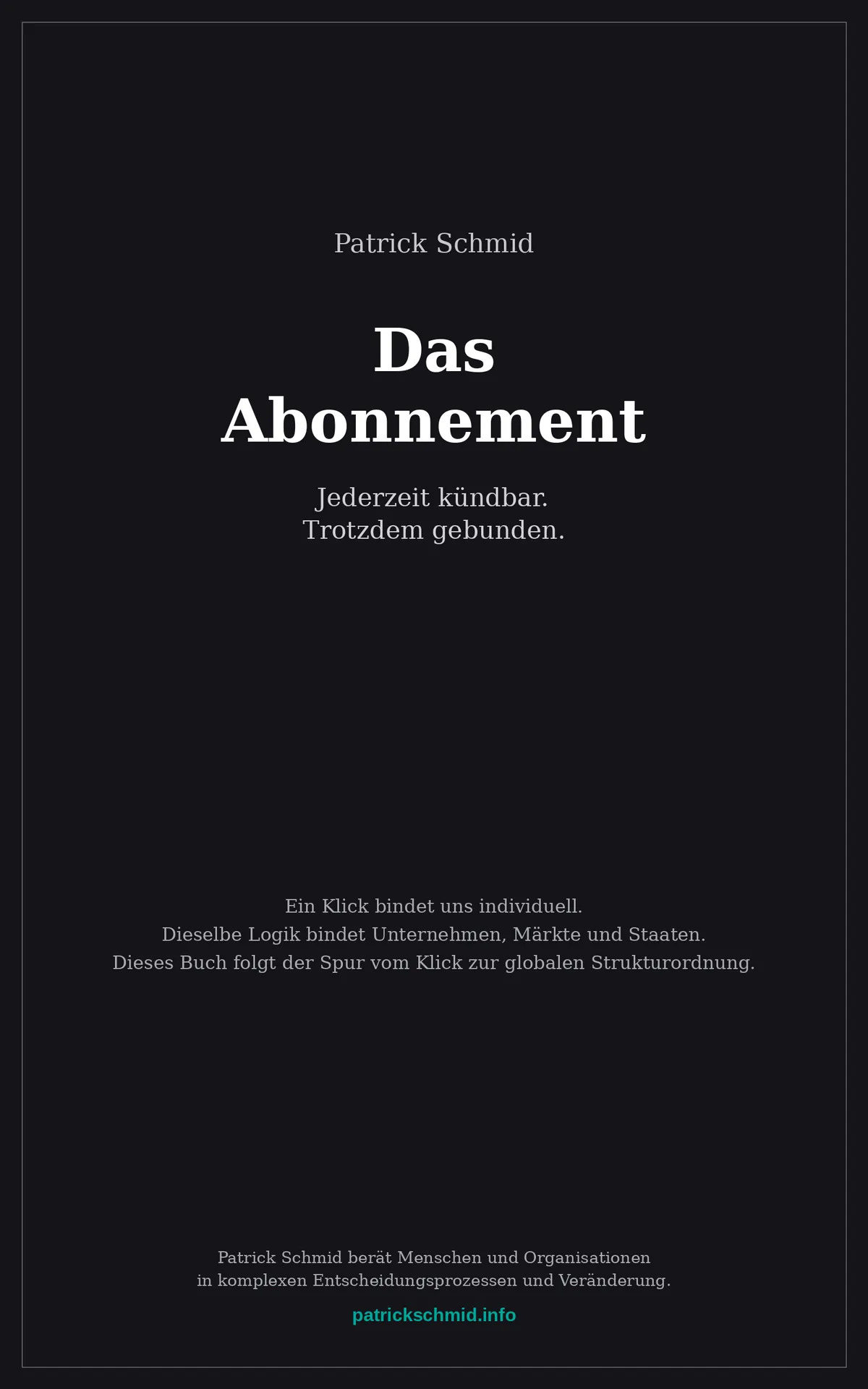
The Subscription
Cancel anytime. Still bound.
A book about the subscription. What is it about?
You did it without noticing. A trial month, a click, and a small decision turned into a lasting commitment. Hardly any area of life today gets by without several subscriptions running in parallel. In theory, you can cancel at any time. In practice, it remains unlikely.
The subscription is not a form of payment but an architecture that organizes time and access—at the expense of ownership. Those who subscribe bind themselves to a structure that can take away at any time what it granted just a moment ago.
The author traces this shift from everyday life through psychology and power to companies that become hostages of their own infrastructure, and on to the geopolitical level, where the same logic operates on a large scale.
For private individuals: a new view of your own subscription landscape.
For decision-makers: an analysis of the dependencies behind every SaaS contract and every cloud migration—and concrete criteria for when a subscription holds up and when it tips over.
The book does not stop at analysis, nor is it a guide to optimizing subscription models. It shows alternatives for users and designers alike, and ends with its real point: No single subscription is the problem. Only their interlocking creates a dependency that no individual can undo alone.
Background
At the end of 2025, I decided to turn one of my ideas into a book. I had been stumbling over the topic of the subscription often anyway, so I set out on a journey to research the most varied dimensions of function, effects and interactions, connections, etc. in the context of subscriptions.
The result surprised even me, because the subscription as a structure has properties and effects that hardly anyone is aware of. We all use subscriptions, as providers or as consumers. But that the structures behind them even help shape the very big stages is something that at least people in decision-making positions should know—and of course everyone else who is interested in how we structure business and life in our digital societies is welcome to know it, too.
Thank you for your interest.
'%20d='m0%200%2016%2011h61%2061%2061%2061%2060L47%2037h61%2061%2060%2061L16%2063h61%2061%2061%2061%2060L47%2089h61%2061%2060%2061L16%20115h61%2061%2061%2061%2060L47%20141h61%2061%2060%2061L16%20166h61%2061%2061%2061%2060L47%20192h61%2061%2060%2061L16%20218h61%2061%2061%2061%2060z'/%3e%3c/svg%3e) United States
United States amazon.de


'%3e%3ccircle%20r='20'%20fill='%23008'/%3e%3ccircle%20r='17.5'%20fill='%23fff'/%3e%3ccircle%20r='3.5'%20fill='%23008'/%3e%3cg%20id='in-d'%3e%3cg%20id='in-c'%3e%3cg%20id='in-b'%3e%3cg%20id='in-a'%20fill='%23008'%3e%3ccircle%20r='.9'%20transform='rotate(7.5%20-8.8%20133.5)'/%3e%3cpath%20d='M0%2017.5.6%207%200%202l-.6%205z'/%3e%3c/g%3e%3cuse%20xlink:href='%23in-a'%20width='100%25'%20height='100%25'%20transform='rotate(15)'/%3e%3c/g%3e%3cuse%20xlink:href='%23in-b'%20width='100%25'%20height='100%25'%20transform='rotate(30)'/%3e%3c/g%3e%3cuse%20xlink:href='%23in-c'%20width='100%25'%20height='100%25'%20transform='rotate(60)'/%3e%3c/g%3e%3cuse%20xlink:href='%23in-d'%20width='100%25'%20height='100%25'%20transform='rotate(120)'/%3e%3cuse%20xlink:href='%23in-d'%20width='100%25'%20height='100%25'%20transform='rotate(-120)'/%3e%3c/g%3e%3c/svg%3e)


'%20transform='translate(88%20-32)'%3e%3cpath%20fill='%23fff'%20d='M-128%2032h720v480h-720z'/%3e%3ccircle%20cx='523.1'%20cy='344.1'%20r='194.9'%20fill='%23bc002d'%20transform='translate(-168.4%208.6)scale(.76554)'/%3e%3c/g%3e%3c/svg%3e)